Cross-modal embeddings, as far as I can tell, are the closest thing we have to a universal translator for machines. Not the Babel fish from Hitchhiker's Guide. Something weirder. Something that lets a model look at a picture of a cat and a sentence about a cat and go "yep, same vibe."
I have been banging my head against this for a few weeks now. The short version: cross-modal embeddings are vector representations that shove information from different formats (text, images, audio, video, the works) into one shared vector space. In that space, semantically related things cluster together regardless of whether they started as pixels or paragraphs.
The longer version is what follows. I tried to keep the hand waving to a minimum.
The Problem That Was Begging for a Solution
Before cross-modal embeddings, you had silos. A vision model only saw images. A text model only saw words. If you wanted to search your photo library for "dog at the beach," you either tagged everything by hand or you built some brittle pipeline that tried to convert one modality into the other and back again. Neither was fun.
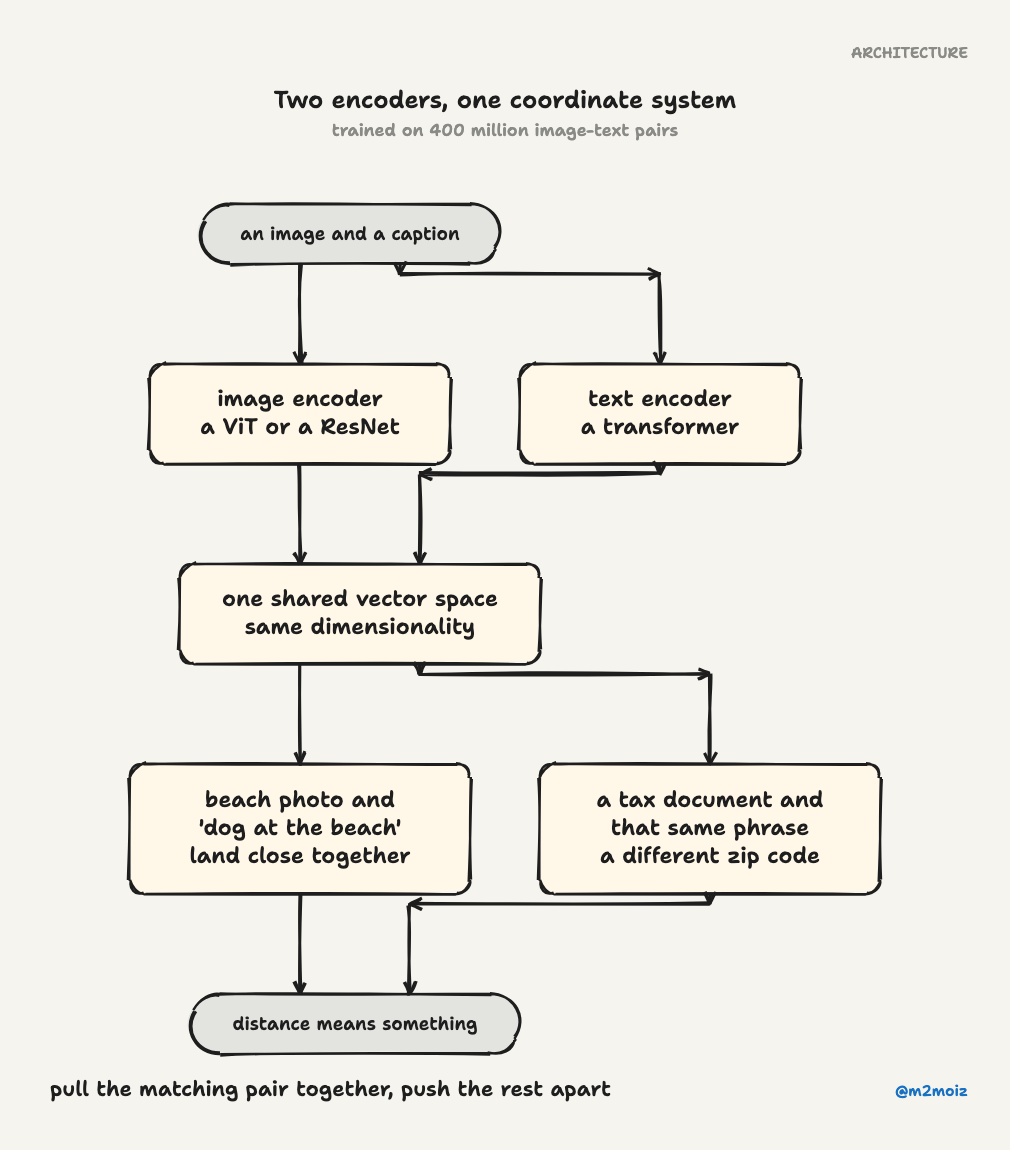
The insight that cracked this open is almost laughably simple: what if you trained a model to map both images AND text into the same coordinate system, where distance actually means something? An image of a Golden Retriever on the sand and the phrase "dog at the beach" would land near each other. An image of a tax document and that same phrase would land somewhere in a completely different zip code.
That is the whole secret. The rest is details.
How It Actually Works (No, You Don't Need a PhD)
The architecture behind these things is not as complicated as you might think. It is called a dual-encoder setup because you run two separate neural networks: one for images, one for text. Or sometimes one for audio and one for video. You get the pattern.
The recipe goes like this:
- Take a batch of image-text pairs (millions of them).
- Run the images through one encoder, the text through another.
- For each pair, nudge the model to pull their embeddings closer together.
- For every non-pair in the batch, push them apart.
This is called contrastive learning, and it is brutally effective. The loss function looks like this, if you are into that kind of thing:
L = -log( exp(sim(v_i, t_i) / tau) / sum_j exp(sim(v_i, t_j) / tau) )
Where v_i is the image embedding, t_i is the text embedding, sim is cosine similarity, and tau is a temperature parameter that controls how "peaky" the distribution gets. Lower tau means the model is more aggressive about separating non-matching pairs.
The whole thing is trained on data scraped from the internet. Captions that humans wrote for their own photos. Alt text. Product descriptions. All the messy, often contradictory signal that comes from people just using language in the wild.
CLIP: The One That Started the Party
OpenAI dropped CLIP (Contrastive Language-Image Pre-training) in 2021 and things got interesting fast. They trained on 400 million image-text pairs. Four hundred million. That scale turned out to matter more than any architectural trick. Smaller datasets produced models that kind of worked. CLIP produced a model that was genuinely, eerily good at matching images to text it had never seen.
The architecture uses a Vision Transformer (or a ResNet, depending on the variant) for images, and a standard transformer for text. Both produce embeddings of the same dimensionality. Then the contrastive loss does its thing.
Using it in code is almost disappointingly easy:
from PIL import Image
from transformers import CLIPProcessor, CLIPModel

model = CLIPModel.from_pretrained("openai/clip-vit-base-patch32")
processor = CLIPProcessor.from_pretrained("openai/clip-vit-base-patch32")
image = Image.open("dog_on_beach.jpg")
texts = ["a photo of a dog", "a photo of a beach", "a photo of a tax return"]

inputs = processor(text=texts, images=image, return_tensors="pt", padding=True)
outputs = model(**inputs)
probs = outputs.logits_per_image.softmax(dim=1)
print(probs)  # hopefully [0.85, 0.12, 0.03]
The model looks at the image, looks at the candidate labels, and ranks them. Zero training on your end. That is the part that still makes me do a double take.
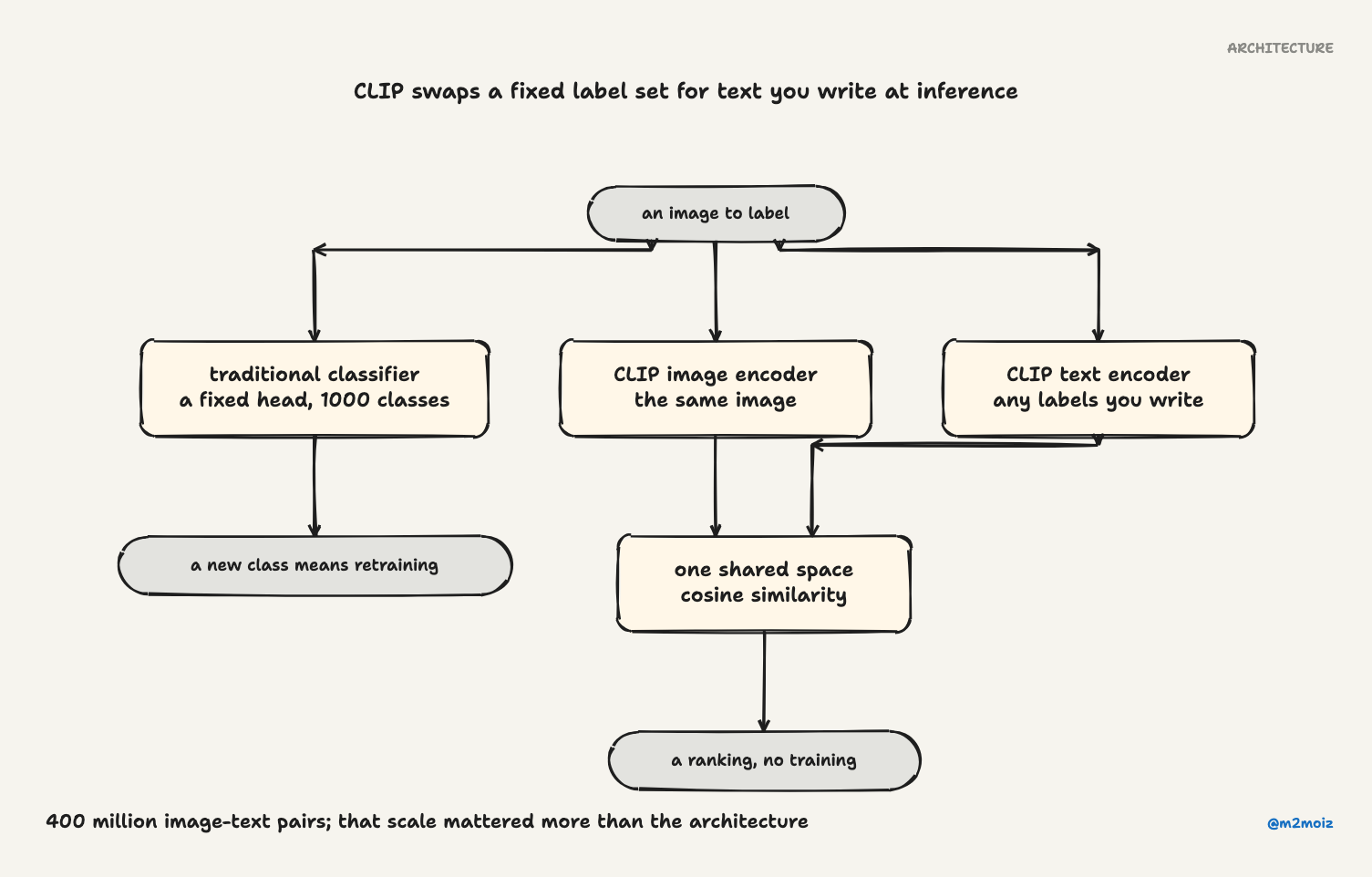
What makes CLIP different is it learns from natural language, not fixed label sets. A traditional image classifier trained on ImageNet can tell you if something is a "tabby cat" because that was one of its 1000 categories. But ask it about "a cat wearing a tiny hat" and it falls apart. CLIP can handle that because the text encoder generalizes.
ImageBind: When Two Modalities Wasn't Enough
Meta took the idea and ran with it. ImageBind aligns six modalities into one space: images, text, audio, depth, thermal imaging, and IMU data (motion sensors).
The wild part is that images act as the binding modality. You do not need training data for every possible pair (like audio-to-thermal or text-to-depth). You only need pairs between images and each other modality. The shared alignment happens through the image hub. Audio of a dog barking and the text "dog barking" end up near each other because both are near the image of a dog barking.
I found this weirdly satisfying when I first understood it. It is a hack, technically. But it is an elegant hack.
Open Source Alternatives That Do Not Cost a Fortune
If you do not want to use OpenAI's API (fair), the open source ecosystem has caught up fast.
OpenCLIP is the community reimplementation with better training recipes and larger model variants. The LAION-5B dataset (that is 5 billion image-text pairs, not a typo) has produced models that compete with or beat the original CLIP on most benchmarks.
import open_clip

model, _, preprocess = open_clip.create_model_and_transforms(
    'ViT-L-14',
    pretrained='laion2b_s32b_b82k'
)
tokenizer = open_clip.get_tokenizer('ViT-L-14')
The ViT-L/14 variant trained on LAION-2B is generally the sweet spot for performance versus compute cost. There are bigger models, but you need a GPU that costs more than my rent.
Building Something Useful: Cross-Modal Search
The most practical thing you can build with cross-modal embeddings is a search engine that takes text queries and finds images. Or vice versa. It is surprisingly few lines of code.
import faiss
import torch

class CrossModalSearchEngine:
    def __init__(self, model, processor):
        self.model = model
        self.processor = processor
        self.index = None
        self.metadata = []

    def encode_images(self, images):
        inputs = self.processor(images=images, return_tensors="pt")
        with torch.no_grad():
            return self.model.get_image_features(**inputs).cpu().numpy()

    def encode_text(self, texts):
        inputs = self.processor(text=texts, return_tensors="pt", padding=True)
        with torch.no_grad():
            return self.model.get_text_features(**inputs).cpu().numpy()

    def build_index(self, image_embeddings):
        dimension = image_embeddings.shape[1]
        faiss.normalize_L2(image_embeddings)
        self.index = faiss.IndexFlatIP(dimension)
        self.index.add(image_embeddings)

    def search(self, query, k=10):
        q = self.encode_text([query])
        faiss.normalize_L2(q)
        scores, indices = self.index.search(q, k)
        return list(zip(indices[0], scores[0]))
Normalising the vectors first turns inner product into cosine similarity, which is why IndexFlatIP is the right starting index: brute force, exact, and the scores it hands back are similarities you can actually read (1.0 is identical). For large collections (millions of vectors), switch to IVF or HNSW. Those return squared L2 distances instead, so the ranking still holds but lower becomes better, and any threshold you tuned against cosine has to be recomputed.
Fine Tuning: Because Pretrained Models Are Never Quite Right
Out of the box, CLIP handles general concepts well. But your domain is probably not "random internet images." It might be medical scans, satellite photography, or in my case, badly lit photos of electronic components at weird angles.
Fine tuning adapts the pretrained model to your specific domain. The contrastive loss stays the same. You just train on your own data.
import torch
import torch.nn.functional as F
from transformers import CLIPModel
from torch.optim import AdamW

def contrastive_loss(image_embeds, text_embeds, temperature=0.07):
    image_embeds = F.normalize(image_embeds, dim=1)
    text_embeds = F.normalize(text_embeds, dim=1)
    logits = torch.matmul(image_embeds, text_embeds.T) / temperature
    labels = torch.arange(len(logits), device=logits.device)
    loss_i = F.cross_entropy(logits, labels)
    loss_t = F.cross_entropy(logits.T, labels)
    return (loss_i + loss_t) / 2

model = CLIPModel.from_pretrained("openai/clip-vit-base-patch32")
optimizer = AdamW(model.parameters(), lr=5e-6)
A few practical notes from having done this badly the first time:
- Use a low learning rate. CLIP is already pretty good. You are just nudging it. 5e-6 is a good starting point.
- Do not train for more than 10 epochs or it will forget how to generalize.
- Your batch size matters a lot. Contrastive learning gets better signal with larger batches because it has more negative examples per positive pair.
- Freeze the vision encoder if your images are similar in structure to what CLIP was trained on. Only fine tune the text encoder. Or vice versa.
Production: Where Things Get Real
Getting cross-modal embeddings to work in a Jupyter notebook is one thing. Putting them in production is another.
Speed Optimization
The biggest bottleneck is the model forward pass. Three things help.
First, quantization drops the precision of weights from float32 to int8. This cuts model size by about 4x and speeds up CPU inference by 2-3x, at a small accuracy cost. CLIP handles this reasonably well because the embedding space is high-dimensional and redundant.
import torch
from torch.quantization import quantize_dynamic

model = quantize_dynamic(
    model,
    {torch.nn.Linear},
    dtype=torch.qint8
)
Second, ONNX export gives you optimized inference through ONNX Runtime. The tradeoff is that some ops are not supported and you lose flexibility.
import torch

torch.onnx.export(
    model, dummy_input, "clip_model.onnx",
    input_names=['input_ids', 'attention_mask'],
    output_names=['output'],
    dynamic_axes={'input_ids': {0: 'batch_size'},
                  'attention_mask': {0: 'batch_size'}}
)
Third, batch processing is the cheapest optimization of the lot. Process 32 or 64 items at once instead of one at a time. The GPU thanks you.
Vector Storage at Scale
Once you have embeddings, you need to store and search them. For small collections (up to a few hundred thousand), you can brute force with NumPy. Beyond that, you need an index.
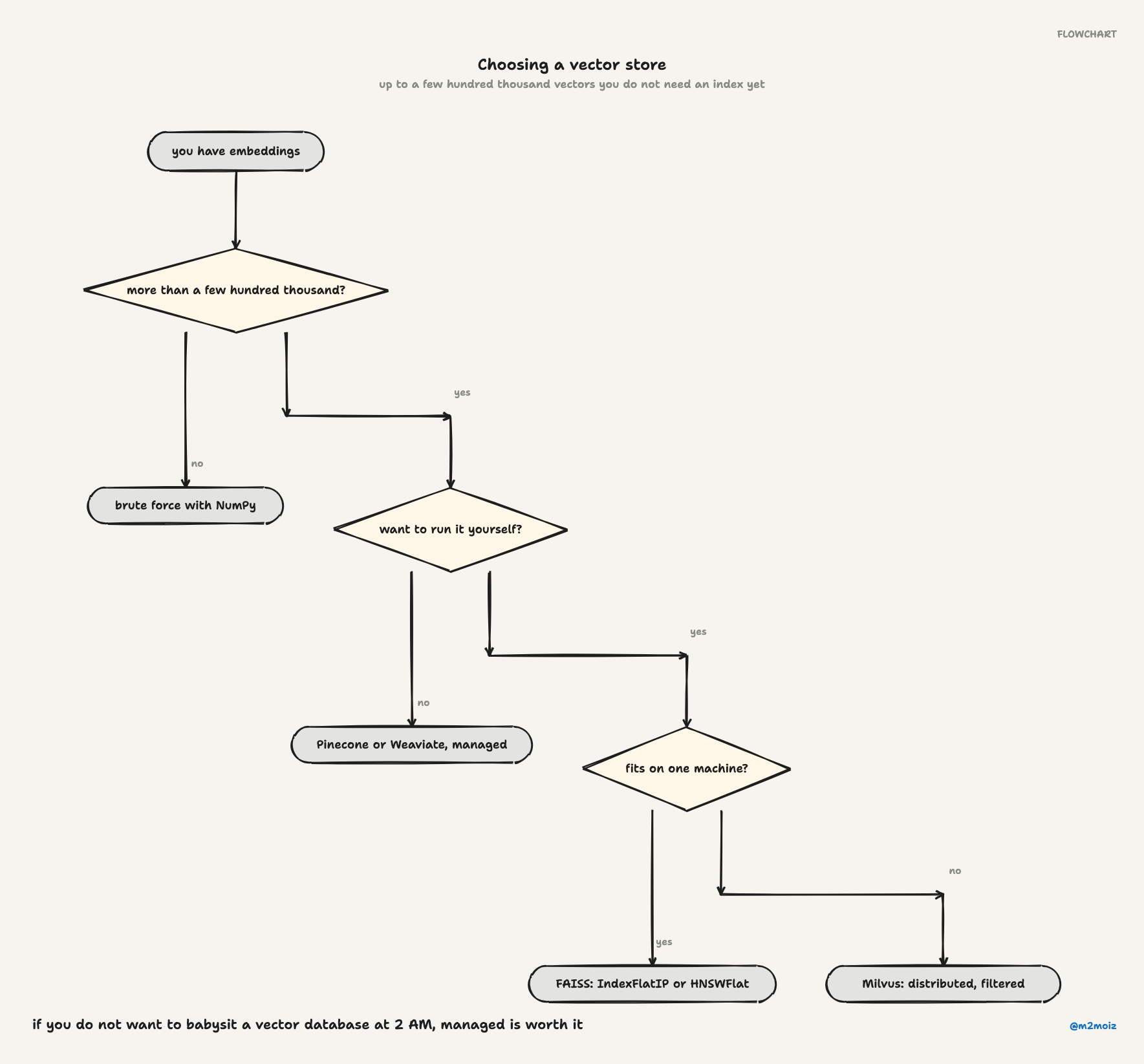
FAISS is the workhorse. IndexFlatIP for exact search on small collections. IndexHNSWFlat for approximate search at scale. It's fast, free, and the default for a reason.
Milvus is a full vector database with distributed support, filtering, and hybrid search. If you need to scale beyond what a single machine can handle, this is the answer.
Pinecone and Weaviate are managed services. They cost money. They handle the ops headaches. If you do not want to babysit a vector database at 2 AM, they are worth it.
Weird Stuff You Can Do With This
Zero Shot Classification
This is the party trick that got everyone excited about CLIP. You classify images into categories the model was never explicitly trained on, by converting the categories into text prompts and measuring similarity.
def zero_shot_classify(image, candidate_labels, model, processor):
    texts = [f"a photo of a {label}" for label in candidate_labels]
    inputs = processor(text=texts, images=image, return_tensors="pt", padding=True)
    outputs = model(**inputs)
    probs = outputs.logits_per_image.softmax(dim=1)
    idx = probs.argsort(descending=True)[0]
    return [(candidate_labels[i], probs[0][i].item()) for i in idx]
This is not a gimmick. It genuinely works for hundreds of categories. But you need to phrase your prompts carefully. "A photo of a {thing}" is the standard format for a reason. Get creative and the results wobble.
Multimodal RAG
The same retrieval-augmented generation pattern that works for text works for multimodal data. You build a knowledge base of image-text pairs. When a query comes in, you encode it as text, find the nearest neighbors in embedding space (matching against both image and text embeddings), and feed the retrieved context to a language model.
Worth being explicit that this is not how a natively multimodal model like GPT-4V handles an image. That runs the image through a vision encoder, projects the visual features into the language model's token space, and attends over pixels and text in the same layers. There is no external index and no per-query retrieval. Multimodal RAG is a separate pattern you build yourself.
Content Moderation
Cross-modal embeddings are actually quite good at detecting problematic content. You define a set of categories ("violent content," "explicit material," etc.), encode them as text, and compare incoming images against those embeddings. If an image lands too close to "graphic violence" in the shared space, you flag it.
The advantage over traditional classifiers is that you can change the categories without retraining. Want to add "gore" to your safety system? Just add the text prompt. You skip the data collection, the labeling, and the whole training pipeline.
The Things That Can Go Wrong
Bias
Cross-modal models inherit the biases of their training data. CLIP was trained on internet data, which means it absorbed every stereotype and skew present in the web. It is better at recognizing dogs from affluent neighborhoods than from rural ones. It associates certain professions with certain genders. The usual story.
There are ways to mitigate this: fine-tune with explicit debiasing objectives, evaluate across diverse demographic groups. But they are bandaids, not cures.
Preprocessing
If there is one thing that will quietly destroy your embedding quality, it is bad preprocessing. CLIP expects images resized and center-cropped to 224x224 pixels, normalized with specific mean and standard deviation values. Get these wrong and your embeddings drift silently.
from torchvision import transforms

transform = transforms.Compose([
    transforms.Resize(224, interpolation=transforms.InterpolationMode.BICUBIC),
    transforms.CenterCrop(224),
    transforms.ToTensor(),
    transforms.Normalize(
        mean=[0.48145466, 0.4578275, 0.40821073],
        std=[0.26862954, 0.26130258, 0.27577711]
    )
])
Yes, those are the exact pixel values from the CLIP paper. No, I do not know why they are so specific. I just use them.
Monitoring
In production, embedding quality degrades over time as your data distribution shifts. Watch the average pairwise distance between embeddings. A sudden drop means your data is becoming less diverse. Watch the silhouette score if you have labeled data. It tells you if clusters are still distinct.
Where This Is Going
More modalities are the natural next step. Touch and smell, maybe even taste. We are not there yet (thankfully? I don't know, actually, a machine that can "taste" your cooking and tell you what is missing might be worth the existential risk).
Efficiency improvements will bring these models to edge devices. Imagine a phone that can do cross-modal search locally without phoning home. That is a year or two out, maybe sooner.
Compositional understanding is the harder problem. Current models can match "cat sitting on a red chair." They struggle with "the cat that the dog chased is now on the red chair while the dog waits below." That sentence is all relationships and ordering and negation, and the embedding space isn't expressive enough for it yet.
Temporal modeling is another frontier. Video embeddings today are mostly frame-by-frame with some averaging. Real temporal reasoning would unlock much better video search and understanding.
The Takeaway
Cross-modal embeddings are not magic. They are a clever application of contrastive learning at enormous scale, combined with architectures that forced different data types into the same vector space. The result is something that looks like understanding from the outside, but is really just very good pattern matching across a learned coordinate system.
I find that distinction comforting. The model does not know what a cat is. It knows that the vector produced by the image encoder for a cat picture ends up in the same neighborhood as the vector produced by the text encoder for the words "a photo of a cat." That is not consciousness. It is math.
But it is really useful math.
If you are building something that connects images and language, start with CLIP. Experiment with fine tuning on your own data. Spend the bulk of your time on the infrastructure around vector storage. The model architecture is largely settled. The engineering is where the value lives.
Now if you will excuse me, I have to go explain to my CLIP model why "a photo of my cat looking judgmental" should not match "a photo of a grumpy old man." It is a work in progress.