I have a confession. I have tried every note-taking app ever made. Every single one. Obsidian, Notion, Roam, Logseq, Evernote, Bear, Apple Notes, Google Keep, TiddlyWiki, a physical Moleskine that I used for exactly three days, and a text file called thoughts.txt on my desktop that currently has 14,000 words of chaos in it. I have built systems and abandoned them. I have tagged and untagged. I have folder-structure-planned and link-hopped. And I have forgotten most of it. Like, embarrassingly most of it.
This is the story of why I stopped tool-hopping and started actually managing my knowledge. And why you might want to too.
What Even Is Personal Knowledge Management?
Personal Knowledge Management (PKM) is a fancy name for a simple thing: a system that helps you keep track of what you know so you can actually use it later. It is a bottom-up approach where you, the knowledge worker, take charge of your own learning instead of letting information wash over you like a tidal wave of half-read articles.
Think of PKM as building a second brain. An external system that stores ideas, notes, resources, and connections so your real brain can focus on the hard stuff: creativity, decision-making, and wondering what you walked into the kitchen for. Instead of letting every good idea evaporate the moment you close the browser tab, a PKM system captures thoughts, links them together, and turns them into something you can actually build on.
Four pieces make it work. First, capture: pull ideas out of the stream and into a bucket. Articles, meeting notes, voice memos, the random thought you had in the shower. Get it down somewhere. Then organize: give that captured stuff enough structure to find later. Folders, tags, links, whatever works. The goal is to turn a pile of notes into something you can actually navigate. Next, retrieve: find what you need without scrolling through 400 notes by memory. A good system makes this feel like magic. Finally, connect: when your notes link to each other, you stop collecting and start synthesizing. You see patterns across domains. You connect the dots between that book you read in 2022 and the problem you are solving today.
The goal: turn information chaos into something you can actually use. Boosts learning and sparks ideas you would otherwise have lost. All from what started as a glorified note-taking habit.
Why This Matters More Than Ever
We live in an age of information firehoses. A friend at a big tech company told me her team spends roughly a full workday per week hunting for things they know exist somewhere (meeting notes, decisions, specs) buried in Slack threads and Google Docs. That is a systems problem dressed up as a productivity one.
Good PKM helps with a few things.
Coping with the noise. The volume of information keeps growing. PKM gives you a way to filter and organize instead of drowning in open tabs.
Externalizing your memory. Human brains are brilliant at creativity and terrible at storage. We forget, we misplace, we can only hold a handful of things in working memory at once. (Miller's famous "seven, plus or minus two" has since been revised down to roughly four once you control for rehearsal.) Getting thoughts out of your head and onto the page lets you think more clearly.
Continuous learning. When you maintain a knowledge base, you start noticing gaps. You see what you do not know. And you can fill those gaps intentionally instead of jumping from one interesting article to the next.
Better decisions. Quick access to the right information can improve your choices. Instead of going with your gut (which is often wrong), you go with evidence you collected when you were not under pressure.
Connecting the dots. This one got me hooked. When your notes link to each other, you start seeing relationships between things that seem unrelated. That marketing campaign from 2019 connects to a psychology paper you read last month, and suddenly you have an idea for something genuinely new. Storage is the easy part. The connections are the whole point.
The Methods That Actually Work
There is no one right way to do PKM. But a few approaches keep showing up in practice.
The Zettelkasten Method (Atomic Notes, Linked Together)
Developed by a German sociologist who wrote so many papers that people still do not believe one person could produce that much, the Zettelkasten is beautifully simple. You write atomic notes. One idea per note. Each note links to others. Over time, the web of connections becomes the thing you are really building, not the notes themselves.
The key rules:
- Each note captures exactly one idea
- Write it in your own words (non-negotiable)
- Link it to existing notes (this is where things get interesting)
- Add it to the system without worrying about where it goes
The Zettelkasten works because it matches how your brain makes connections. It does not force your knowledge into a rigid folder tree. It grows organically. More on the garden metaphor later.
The PARA Method (For People Who Like Structure)
Tiago Forte's PARA system takes a different approach. Instead of organizing by topic, you organize by actionability. Everything goes into one of four buckets:
- Projects: Short-term efforts with a specific outcome (write a blog post, plan a vacation)
- Areas: Long-term responsibilities (health, career, finances)
- Resources: Topics or references of interest (books you read, frameworks you like)
- Archive: Inactive stuff from the other three buckets
PARA forces you to ask: what is this note for? If it does not support a project or an area, does it need to be in your system at all? It is ruthless. And it works well for people who think in terms of goals and deliverables rather than topics and concepts.
I personally use a hybrid physical-and-digital system that is probably not pretty enough to put on YouTube. Notes that feel permanent and conceptual live in my Zettelkasten. Notes tied to specific outcomes live in PARA-style project folders. The two systems link to each other. It is not pure, but it works.
The CODE Loop
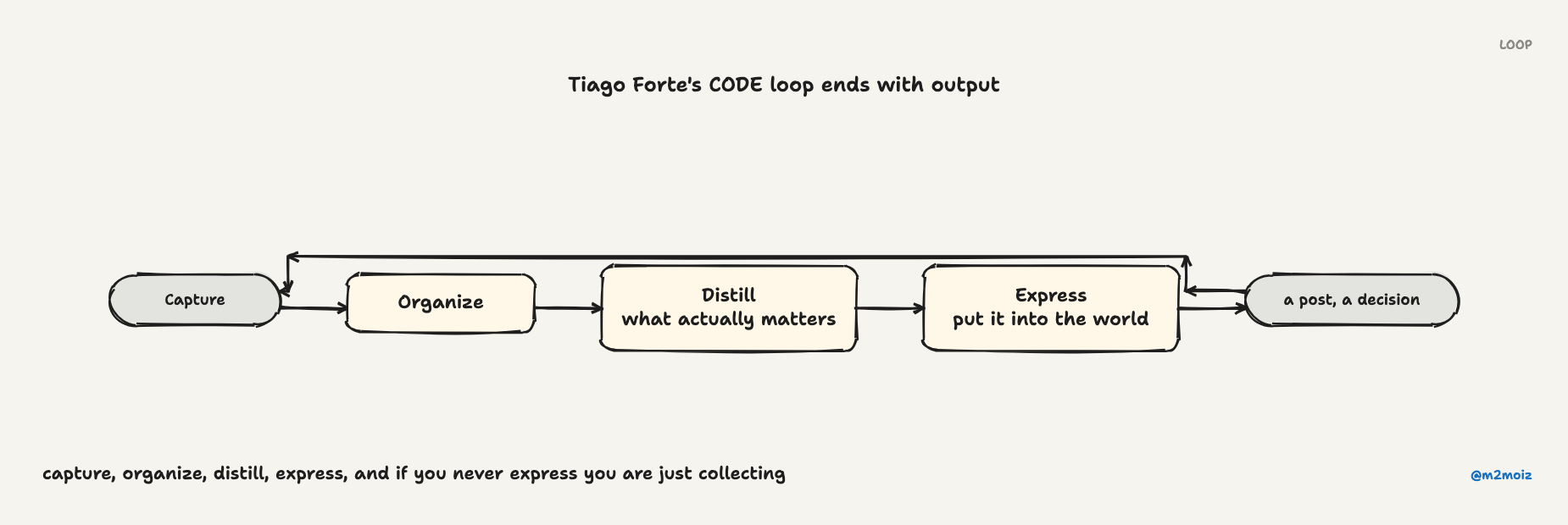
Capture, Organize, Distill, Express. Another framework from Forte's work, but useful as a reminder that PKM is not about hoarding. The cycle ends with output. You capture ideas, organize them, figure out what actually matters, and then express the result. A blog post, a decision, a conversation, a product. If you never express, you are just collecting.
Regular Review (The Part Everyone Skips)
Capturing and organizing are the fun parts. Review is the chore. But it actually matters. Without review, your system becomes a graveyard of good intentions. Schedule a weekly or monthly scan of recent notes. Revisit old connections. Update notes that have gone stale. Set up spaced repetition for key facts if you are the type who enjoys flashcards.
The reward: when you revisit old notes, you make new connections. The "oh, this relates to that" moments happen during review, not during capture.
What I Actually Learned
After years of tool-hopping and system-building, here is what I keep coming back to. PKM is not about having the perfect setup or finding the one true app. It is about being intentional with information instead of letting it pile up unread.
A pile of notes is not knowledge. But a pile of notes that you connect, revisit, and distill over time, that starts to become something else. That is a second brain. And it gets better the more you put into it.
Part 2 of this series covers the actual tools and a practical setup guide. Which apps are worth your time, which ones are traps, and how to build a system that does not fall apart after three weeks.