I spent months feeling guilty about a $20 subscription I was barely using. Then something flipped, and now I'm here.
I signed up for a premium AI assistant around the same time everyone else did, back when it felt like a futuristic toy rather than an actual tool. I'd poke at it once a week, ask it to explain something I could have Googled faster, nod approvingly, and close the tab. Rinse and repeat. Every month the credit card charge rolled in, and every month I felt a small wave of shame. $20 for a consultant on every conceivable topic who is infinitely hardworking and instantly available, and I was using it like a novelty calculator.
Then, late last year, something changed. Not in a "new version number" kind of way. The release notes barely hinted at it. But the thing in the chat box suddenly got scary good. Good enough that I went from "I should find something to use this for" to "I have more things I want to ask than hours in the day."
I got curious about how dramatic the shift actually was. So I did what any normal person would do. I exported my entire conversation history and turned it into graphs.
The Numbers Are Embarrassing
The cumulative word count tells the whole story with no effort. Before the quality threshold was crossed, I was sending maybe a paragraph a day. After, I was writing short novels.
On a weekly basis, the discontinuity is impossible to miss. Conversations per week jumped from a sleepy trickle to something that looked like a busy Slack channel. Messages per week (the number of times I hit "send") went from "practically nothing" to "I should probably touch grass." Words per week hit numbers that made me wonder if I was outsourcing my inner monologue.
The daily averages are almost cartoonish:
| Metric | Before the Shift | After the Shift | Change | |--------|:-:|:-:|:-:| | Conversations per day | 1.6 | 5.6 | +252% | | Messages per day | 3.7 | 20.2 | +449% | | Words per day | 89.5 | 740.6 | +727% |
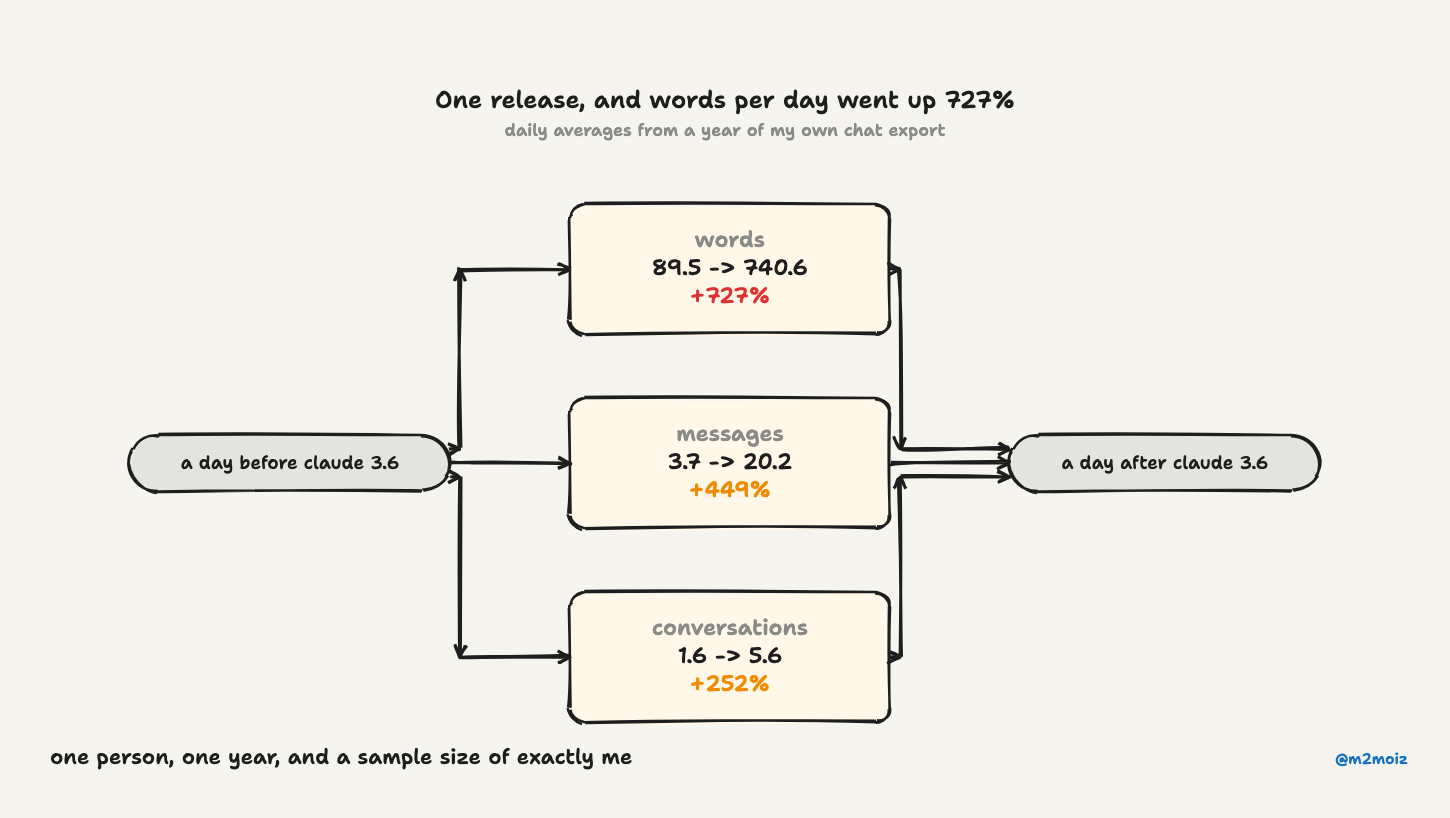
A 727% increase in the number of words I'm typing to a machine. If this were a stock chart, you'd be reading about my trading scandal on the news.
So What Am I Actually Talking About?
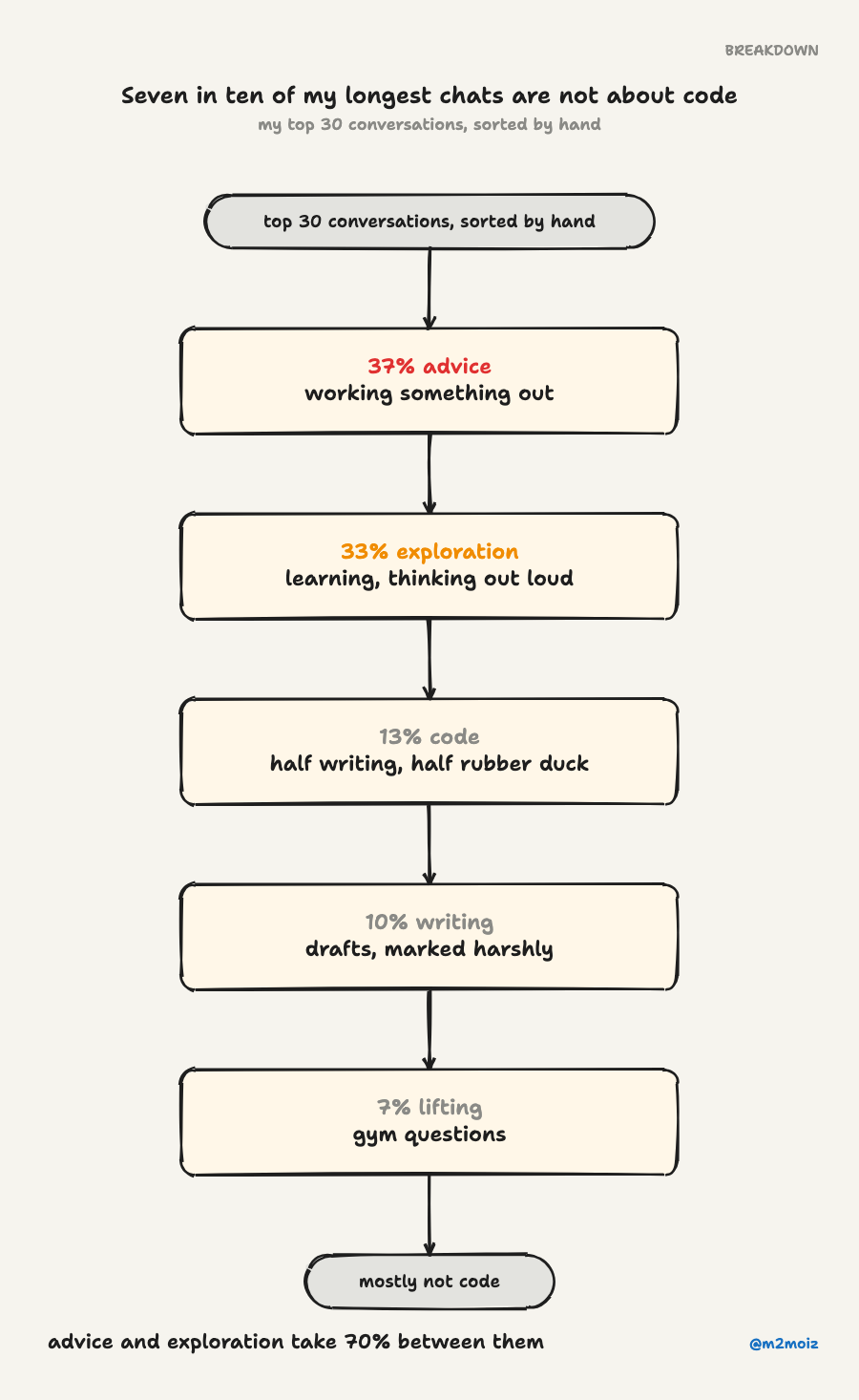
I went through my longest conversations and sorted them into buckets. The results surprised me:
The biggest bucket, by a comfortable margin, is what I call "Working Through Stuff." This is me bringing my mental clutter to an infinitely patient listener. Anxiety about a decision I need to make. Aversion to a task I'm avoiding. Analysis paralysis on a choice that probably doesn't matter. The bottleneck in most of my problems isn't information; I just run out of fresh angles after about five minutes of thinking alone, and by then I've exhausted every thought I'm going to have on my own. Talking to someone else, even a text-based someone who lives in a datacenter, lets me sample perspectives I wouldn't have generated solo.
The second biggest, nearly tied, is "Exploring Ideas." This is the fun stuff. Open-ended conversations where I'm not trying to solve anything specific. I'm just curious about something and want to walk through it with a partner who knows everything and never gets bored. I've learned more about topics I was already interested in through these rambling dialogues than through any structured course.
Code comes in at 13%, and even that is split. About half is asking it to write something for me. The other half is using it as a rubber duck. I talk through tradeoffs and question my assumptions until I catch the thing I was about to overlook.
Writing critique is 10%. I send it drafts and ask it to be mean. Not mean about grammar. Mean about structure, logic, gaps in the argument. It's surprisingly good at this, and surprisingly gentle about it. More than I can say for some of my early career editors.
And yes, 7% is gym questions. Not going to elaborate.
The Threshold I Did Not Know Existed
What actually changed? Because it wasn't one big thing. A thousand small things added up to a gestalt shift.
The model got more reliable. Before the shift, I was always on guard. When I asked it to teach me something, I kept one eye on the output looking for hallucinations. That skepticism is friction. It's hard to get into a flow state when you're fact-checking every sentence. After the shift, that vigilance mostly melted away. For well-trodden subjects like history, physics, and programming languages that aren't obscure, the hallucination problem is basically solved. And for niche topics, it now volunteers warnings: "I might be making some of this up, double-check the details." Which is more honesty than I get from most search results.
The reliability unlocked a cycle. Every time it excelled at a task, my "use the AI" reflex got a little bump. The higher that reflex sat, the more adjacent tasks I tried. The more adjacent tasks I tried, the more I found places where it fit naturally. The uses suggested themselves.
I started using it for things it was never designed for. Web search, for example. Googling something feels like wading through an actively hostile environment. SEO sludge, AI-generated content farms, ten paragraphs of blogspam before the recipe. Asking the chat interface is pleasant? It's at least okay, and often actually good. I don't even mind that its knowledge cuts off months ago. If I could give it live search access, I'd never open a browser again.
The Part I Cannot Graph
I can't graph this part: it's fun.
Exploring ideas with this thing is enjoyable. It knows enough context that I can use weird metaphors, reference obscure things, draw connections from left field, and it keeps up. Every time. There's no "I don't get it," no "can you rephrase that." Nobody sighs on the other end.
Sometimes at the end of a long session, I ask it to generate whatever it wants. The results are wildly inconsistent. Sometimes a little interactive toy, sometimes an SVG that looks like it was drawn by a talented toddler. One of them was its attempt at paradise. Fountain, fruit trees, stylized animals, birds, mountains. None of it quite works visually, and that's exactly why I love it. It's trying. It's doing its best with the tools it has.
I feel lucky to be alive when this exists. There's a weird, completely unearned sense of pride in it, the fact that we built something this remarkable, something that makes you feel like you're talking to a mind. Even when that mind draws paradise like a seven-year-old with a new box of crayons.
What Surprised Me
The numbers told me something I already suspected but didn't want to admit. My thinking saturates in about five minutes. After that, I need someone else in the room.
I used to think that meant I needed better friends, or a therapist, or a more engaged team. Maybe I do. But a chat interface with a really good model behind it fills a surprising amount of that gap. Not because it's human. It clearly isn't. But because it's different. It brings different associations and framings, a different way through the same forest.
The 727% number is embarrassing. But I think it's worth every word.