I got diagnosed with ADHD in my late twenties. Not the TikTok kind. The real kind, where a psychiatrist looks at your test results, then at you, and says "I'm genuinely surprised you've been functioning as well as you have."
That sentence is doing a lot of work. The "as well as you have" part is doing most of it.
This part covers the big picture: the underlying philosophy and mental models, plus the things you have to accept before any system will actually stick. Part two gets into the specific tools and daily tactics.
Chemistry Is the Tech Tree
The first-line treatment for ADHD is stimulants. I didn't want to hear that either. Everything else I'm going to describe in both parts works best as a supplement to medication, not a replacement. Most of these strategies I could only execute after I started taking the right drugs.
I spent years trying to white-knuckle it. Bullet journals. Rigorous schedules. Self-help books. YouTube productivity gurus who speak in motivational slogans. None of it stuck. Not because I wasn't trying hard enough. My brain chemistry was just not cooperating.
It's like a tech tree in a strategy game. Medication is the prerequisite technology. Everything else. The todo lists, the pomodoro timers, the carefully organized Obsidian vault. Those are all locked behind it. You can't research advanced tactics until you've got the basic chemistry node unlocked.
What Pill-Shaming Looks Like
There's a lot of cultural baggage around taking medication for mental stuff. A voice that says you're taking the easy way out. That you should be able to handle this yourself. That relying on a pill is weakness.
I had to learn to ignore that voice. We are biochemical machines running on salt water and electrical signals. Your brain doesn't function properly? Sometimes you need to adjust the chemistry. It's maintenance, not cheating.
The Melatonin Example
I struggled with sleep hygiene for years. It was like World War One: I kept throwing wave after wave of discipline at the problem, and it kept failing. I set an alarm for 10 PM that said "go to bed." You know how many times I obeyed it? Zero. I was always in the middle of something more interesting.
What finally fixed it was melatonin. Not willpower. Not some elaborate bedtime routine. A tiny hormone pill.
I have an alarm at 8 PM that just says "take melatonin." That's it. I'm not committing to log off. I'm not committing to start my nighttime routine. I'm just committing to swallow a small pill, which takes about three seconds.
Thirty minutes later, something shifts. I want to sleep. The melatonin changed my preferences. And when I want to sleep more than I want to scroll through Wikipedia or watch one more YouTube video, I don't need willpower to close the browser. I just close it.
Medication changes what you want. When the wanting shifts, you don't have to force anything.
The Internal-External Ladder
Personal growth for an ADHD brain is a conversation between two kinds of changes:
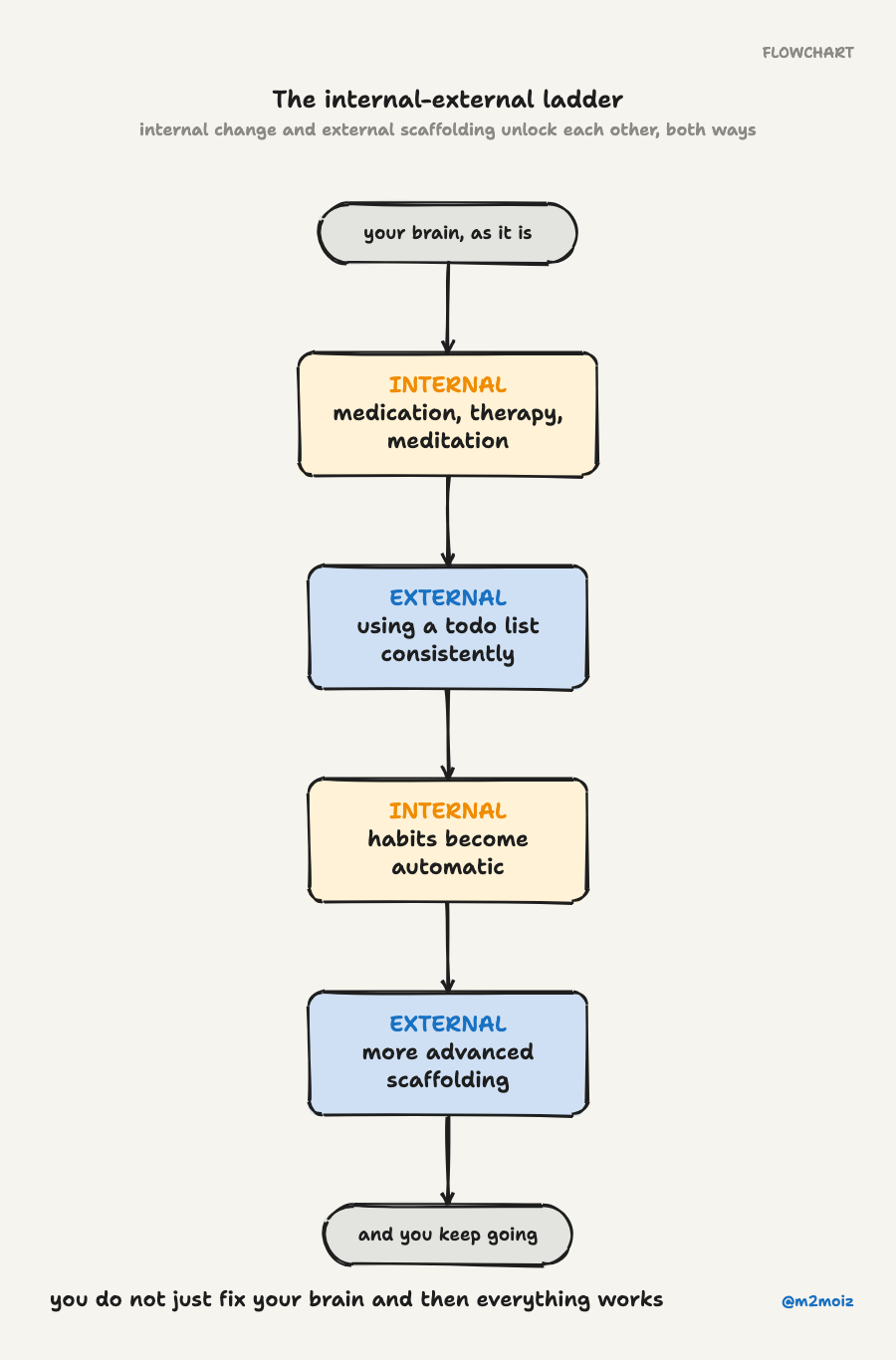
Internal changes: medication, therapy, meditation, habits you've practiced long enough that they've become automatic.
External changes: the scaffolding you build around your brain. A todo list. A calendar. A clean desk. A journaling system. All the stuff that does the remembering and ordering so your brain doesn't have to.
Neither one works without the other. Taking Ritalin without a plan for what you're going to do with your day is pointless. Having an elaborate todo list system while your brain refuses to execute any of it is equally pointless.
The way it actually works is a ladder. Internal change (medication) unlocks your ability to build external scaffolding (using a todo list consistently). That external scaffolding helps you form new habits (making your bed every day, brushing your teeth without fighting yourself). Those habits become internal changes. And then you can build more external scaffolding on top of that.
It goes back and forth. They unlock each other. You don't just fix your brain and then everything works. You build a relationship between your internal state and your external environment, and you keep iterating.
Energy Is Voltage, Not a Battery
You've probably run into "spoon theory" for mental energy. The idea that you wake up with a certain number of spoons, every activity costs spoons, and when you run out, you're done.
That model never quite worked for me. Energy doesn't feel like discrete, fungible units. It feels more like voltage.
Some machines need a certain voltage threshold to operate. Below that threshold, they don't just run slower. They don't run at all. Different activities have different voltage requirements:
-
Things I am deeply averse to. Work that triggers difficult emotions, tasks I've been procrastinating for weeks, interactions I'm dreading. These require the highest voltage.
-
Creative, open-ended work. Writing, coding, designing, thinking. High voltage to start. Medium voltage to sustain once you've broken through the activation barrier.
-
Simple chores. Washing dishes. Folding laundry. Answering a quick email. These run on very low voltage.
And voltage declines throughout the day. When I wake up, I have maximum voltage. By evening, it's approaching zero.
So I do the thing I dread most as early in the morning as possible. Not after breakfast. Not after checking email. First thing, after my morning routine. Because if I push it to late morning, then why not push it to after lunch? And then it's 7 PM and I physically cannot think about the task anymore. The voltage is gone.
After the dreaded thing is done, I do creative work while I still have voltage for it. Then, when I'm too drained to create, I read. When I'm too drained to read, I do chores or go to the gym. And when the sun goes down, everything starts to unravel. The dopamine-seeking gremlin takes over, so I take my melatonin and try to be in bed before I do something stupid.
Three Flavors of Procrastination (And None of Them Are Laziness)
Learning to distinguish between kinds of procrastination helped a lot. Different causes, different fixes.
ADHD Procrastination
This is the simplest one. You want to do the thing. You actually want to do it. But you keep getting distracted. You open the document, then somehow you're on Reddit. You start the task, then your phone buzzes and it's gone.
The fix: medication plus a productivity system plus a few tricks. This is the type of procrastination that responds best to tactical interventions.
Anxious Procrastination
This one is harder. You know what you need to do. Cognitively, it's clear. But doing it triggers difficult emotions. Dread, mostly, with fear and shame underneath. So you avoid it.
Short term, the only way through is to do it scared. Accept the anxiety and act anyway. Asking for help works too. Sometimes having another person in the room when you hit send on that email makes all the difference.
Long term, you need to write down the things you procrastinate due to anxiety and look for patterns. What's the common thread? What emotional root cause keeps surfacing? Identifying it is the first step to actually fixing it.
Decision Paralysis Procrastination
This is the hardest one, because you genuinely don't know what the right choice is. You have options. There are arguments for and against each one. There's uncertainty about outcomes. And so you just ruminate endlessly, stuck in a loop.
I don't have a perfect fix for this. But a few things help:
Talking to people. Friends, therapists, AI assistants. Thinking by yourself has diminishing returns. You quickly exhaust all the thoughts you'll have and start going in circles. Another person brings perspectives you'd never have considered.
Writing it down. Thinking in your head is circular because your working memory is limited. You can only hold so many variables. Writing turns the problem into something physical. You can name the arguments. Number the bullet points. Treat the decision like an engineering problem you're trying to solve on paper rather than in your skull.
Journaling: The Pattern Detector
I keep a hierarchical journal in Obsidian. The structure looks like this:
Journal/
  Daily/
    YYYY/
      MM/
        YYYY-MM-DD.md
  Weekly/
    YYYY/
      YYYY-WW.md
  Monthly/
    YYYY/
      YYYY-MM.md
  Yearly/
    YYYY.md
Every morning I finish yesterday's entry and start today's. Every Sunday I write a weekly review. The first of each month I review the month. The first of the year I review the whole year. The time spent scales with the time span: daily entries are quick and freeform, the monthly review takes an hour, the yearly review takes a whole morning.
I started journaling for vague reasons and it took years before it became a consistent habit. But after three years of doing it, the benefits are clear:
Noticing patterns. You can't change maladaptive patterns until you notice them. It's easy to travel in the same orbit day after day without realizing it. Writing forces you to see the shape of your own behavior.
A default dumping ground. I used to have ideas and observations but nowhere to put them. Not knowing where to file something meant I just didn't write it. Now I just write it in the journal. Later, if it's valuable enough to put somewhere more permanent, I do.
Morning intention-setting. Creating a journal entry in the morning is a good excuse to look at your goals for the day and restate them to yourself.
Proof that things change. There's a weird thing that happens with productivity: when you grind your executive function enough, things that used to be hard become normal. What was the ceiling becomes the floor. You no longer feel proud that you did the thing that would have seemed impossible six months ago. You just feel normal. Journaling helps you see that you actually did get better, even when it doesn't feel like it day to day.
On Time and Two Kinds of Urgency
Managing time comes in two flavors: big picture and moment-to-moment.
The Big Picture: Calendars
I use my calendar lightly. Mostly for social stuff so I don't double-book myself, and for scheduling the gym (which has annoyingly complex constraints: exactly N times per week, at most once per day, adjacency rules for muscle groups, strategic rest days).
The calendar can work as a self-binding device: if there's a project you keep dragging along because you "haven't made time" for it, make a time block. Creating a calendar event is literally making time. It's calling malloc_time().
But I don't use the calendar as my todo list. Some people do, and it works if your tasks are coarse-grained. Mine aren't. Also, calendars are too time-bound: if I schedule a block for something and don't do it, the calendar just moves on. It doesn't know I failed. A todo list drags everything along until I actually complete it.
The Moment-to-Moment: Timers
The problem with todo lists is they're timeless. You look at the list and think "I could do this now, or in five minutes, or in an hour, or tomorrow." There's always time left. The list has no sense of urgency.
The Pomodoro method is the standard fix here, and if you have ADHD you've probably tried it and bounced off. The way it's usually framed feels very neurotypical. It's scaffolding around doing, but for ADHD people, the problem isn't usually the scaffolding. It's the doing itself.
Three contexts where Pomodoro actually works:
Overcoming aversion to a pile of microtasks. When you have ten small things to do (reply to five different people, fill out one form, move one file), the number of them makes the whole seem overwhelming even though each individual task takes seconds. The timer turns it into a game. You trade 25 minutes of mild discomfort for the whole day's peace. And you're usually done in ten minutes.
Starting. The problem is often just starting. You don't want to do the thing, but you want to want to do it. Committing to a half hour is manageable. It's not months or weeks or even hours. It's one timer. And often you start the timer and end up working for four hours.
Stopping. The flip side: sometimes you hyperfocus and one project eats all the time you allocated for everything else. The gym suffers. Sleep suffers. The timer going off is permission to stop and switch gears. The five-minute break is also a good reminder to stand up and unround your shoulders.
What's Coming in Part Two
All of that was the foundation. The philosophy, and the mental models you need before the tactics make sense.
In Part Two, I'll cover the actual daily systems: how I use my todo list as a literal brain extension, the "always visible" trick for not forgetting things, inbox management for the chronically overwhelmed, the accountability buddy hack, my task selection algorithm, the things I've discovered that derail my productivity (music and morning deadlifts, apparently), the fine art of knowing when you're just spinning your wheels, and why I put travel time on my calendar as its own event.